Low-Grade Glioma: Radiation Therapy Overview
English Version
1. Indications for Radiation Therapy
Low-grade gliomas (LGG) are slow-growing brain tumors that typically arise in young adults. Radiation therapy is considered in several scenarios:
- Post-Surgical Treatment: After incomplete resection or biopsy of the tumor.
- Tumor Progression: When there is evidence of tumor progression or recurrence.
- Symptomatic Patients: Patients with neurological symptoms due to tumor location or size.
- High-Risk Features: Presence of factors such as large tumor size (>6 cm), age over 40, or specific histological subtypes like oligodendrogliomas.
2. Treatment Field
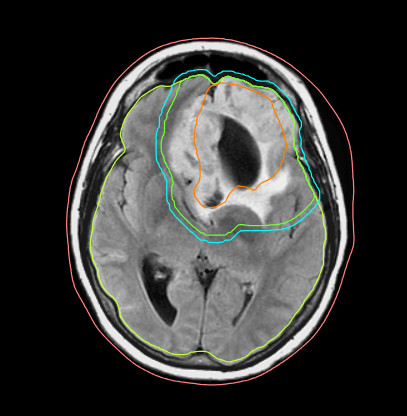
- Target Volume: The radiation therapy typically targets the tumor bed and a margin to account for microscopic disease spread. The Clinical Target Volume (CTV) may include the tumor with a 1-2 cm margin to cover microscopic extension.
- Planning Target Volume (PTV): The PTV accounts for setup errors and patient movement, adding an additional margin (usually 0.5 cm) to the CTV.
3. Radiation Dose
- Standard Dose: For low-grade gliomas, the typical radiation dose ranges from 50.4 Gy to 54 Gy, delivered in 1.8 Gy fractions over approximately 5.5 to 6 weeks.
- Dose Escalation: Higher doses are not commonly used due to the increased risk of neurotoxicity without significant evidence of improved outcomes.
- Fractionation: Conventional fractionation (1.8-2 Gy per fraction) is standard, ensuring a balance between efficacy and minimizing late side effects.
4. Treatment Techniques
- 3D Conformal Radiation Therapy (3D-CRT): Commonly used, it allows precise targeting of the tumor while sparing surrounding healthy tissue.
- Intensity-Modulated Radiation Therapy (IMRT): An advanced technique that modulates the radiation dose intensity, offering better sparing of normal tissues like the brainstem and optic nerves.
- Proton Therapy: May be considered in select cases for younger patients to reduce long-term radiation effects due to its ability to limit dose to surrounding tissues.
5. Side Effects
- Acute Effects: Fatigue, hair loss in the treated area, and mild skin reactions.
- Late Effects: Cognitive decline, endocrine dysfunction, or secondary malignancies. These risks are typically lower with lower radiation doses used in LGG.
6. Follow-up
- Imaging: Regular MRI scans post-treatment to monitor for recurrence.
- Neurocognitive Testing: Periodic assessment of cognitive function to identify and manage potential late effects.
Korean Version
1. 방사선치료 적응증
저등급 신경교종(LGG)은 주로 젊은 성인에게 발생하는 성장 속도가 느린 뇌종양입니다. 방사선치료는 다음과 같은 경우에 고려됩니다:
- 수술 후 치료: 종양의 불완전 절제나 생검 후.
- 종양 진행: 종양의 진행 또는 재발 증거가 있을 때.
- 증상이 있는 환자: 종양의 위치나 크기로 인한 신경학적 증상이 있는 환자.
- 고위험 요인: 큰 종양 크기(>6cm), 40세 이상, 또는 올리고덴드로글리오마와 같은 특정 조직학적 아형.
2. 치료 범위
- 표적 부위: 방사선치료는 일반적으로 종양 부위와 미세 질병 확산을 고려한 여유 마진을 대상으로 합니다. 임상 표적 부위(CTV)에는 종양과 미세한 확장을 포함하기 위해 1-2cm의 마진을 추가합니다.
- 계획 표적 부위(PTV): PTV는 환자의 이동과 설정 오류를 고려하여 CTV에 추가적으로 약 0.5cm의 여유 마진을 더한 것입니다.
3. 방사선 선량
- 표준 선량: 저등급 신경교종의 경우, 일반적인 방사선 선량은 50.4 Gy에서 54 Gy 사이로, 약 5.5~6주 동안 1.8 Gy 분할로 투여됩니다.
- 선량 증강: 선량 증가는 신경독성 위험 증가로 인해 일반적으로 사용되지 않으며, 결과 개선에 대한 충분한 근거가 부족합니다.
- 분할: 표준 분할 방식(1.8-2 Gy/회)은 효과와 지연된 부작용 최소화의 균형을 맞추기 위해 사용됩니다.
4. 치료 기법
- 3차원 적형 방사선치료(3D-CRT): 종양을 정밀하게 타겟팅하면서 주변 건강 조직을 보호할 수 있는 방법으로 자주 사용됩니다.
- 강도 변조 방사선치료(IMRT): 방사선 강도를 조절하여 방사선이 뇌간 및 시신경과 같은 정상 조직을 보호할 수 있게 해주는 고급 기술입니다.
- 양성자치료: 젊은 환자에게 장기 방사선 효과를 줄이기 위해 선택적으로 고려될 수 있으며, 주변 조직에 대한 방사선 노출을 제한할 수 있습니다.
5. 부작용
- 급성 부작용: 피로, 치료 부위의 탈모, 가벼운 피부 반응 등이 있습니다.
- 지연된 부작용: 인지 기능 저하, 내분비 기능 장애, 또는 이차 암 발생. LGG 치료에 사용되는 낮은 방사선 선량으로 인해 이러한 위험은 일반적으로 낮습니다.
6. 추적 관리
- 영상 검사: 치료 후 정기적으로 MRI 스캔을 통해 재발 여부를 모니터링합니다.
- 신경인지 테스트: 인지 기능의 주기적 평가를 통해 잠재적인 지연된 부작용을 확인하고 관리합니다.


Low-Grade Glioma: Radiation Therapy Overview
English Version
1. Indications for Radiation Therapy Low-grade gliomas (LGG) are slow-growing brain tumors that typically arise in young adults. Radiation therapy is considered in several scenarios:
2. Treatment Field
3. Radiation Dose
4. Treatment Techniques
5. Side Effects
6. Follow-up
Korean Version
1. 방사선치료 적응증 저등급 신경교종(LGG)은 주로 젊은 성인에게 발생하는 성장 속도가 느린 뇌종양입니다. 방사선치료는 다음과 같은 경우에 고려됩니다:
2. 치료 범위
3. 방사선 선량
4. 치료 기법
5. 부작용
6. 추적 관리